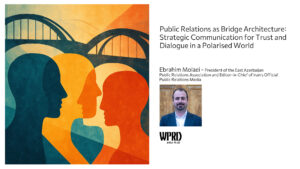
Ebrahim Molaei – President of the East Azerbaijan Public Relations Association and Editor-in-Chief of Iran’s Official Public Relations Media
In today’s world—often described as an era of social and media-driven polarization—deep intellectual and emotional divides have emerged within societies. Traditional media and social networks alike have become battlegrounds for opposing viewpoints, narrowing the space for healthy dialogue. In such an atmosphere, public trust in institutions and official discourse has significantly eroded, and each group tends to view the other as a threatening “other.”
This critical situation has amplified the responsibility and significance of public relations professionals more than ever before. Public relations, when approached strategically, can serve as the architect of communication bridges—replacing deepening divides with pathways of connection, understanding, and mutual respect.
Social and Media Polarisation
Polarisation refers to a condition in which society becomes sharply divided into opposing ideological or emotional camps, making dialogue and mutual understanding increasingly difficult. As highlighted in Daniel Kahneman’s Thinking, Fast and Slow, a major driver of this phenomenon lies in the emotional mechanisms of the human mind. In other words, much of our decision-making and judgment is driven not by logical reasoning, but by instinctive and emotional responses. Polarising agents exploit this cognitive vulnerability by crafting emotionally charged and simplistic narratives—such as the imaginary binary of “absolute good versus absolute evil”—to provoke audiences into taking sides without deeper reflection. The result is a media and political landscape where rational discourse is displaced by emotional combat, and each side seeks to discredit the other through mobilised sentiment.
The role of media in this context is twofold. On the one hand, traditional and especially social media platforms create echo chambers and filter bubbles that isolate like-minded individuals and reduce exposure to differing opinions. This fosters a sense of self-righteousness and a belief that the opposing side is entirely misguided. As Marshall McLuhan once noted, modern media have turned the world into a “global village.” Yet paradoxically, these same globally connected networks have enabled the rise of separate “identity tribes”—tight-knit, ideologically rigid online communities that are increasingly disconnected from one another.
On the other hand, the roots of polarisation often lie deep within society itself, and media more often serve to amplify these divisions than to create them. As Manuel Castells, a leading sociologist of communication, explained in an interview with Lece Online, political polarisation stems from deeper social issues, while social networks act as accelerators and multipliers of these divides.
Thus, media function as a double-edged sword: they can either foster mutual understanding through responsible storytelling or inflame tensions by spreading sensationalism and distorted information. The critical challenge in today’s polarised age is to harness the power of media and communication not to widen the rifts, but to restore trust and rebuild the social fabric.
Public Relations as the Architecture of Dialogue Bridges
Historically, public relations has often been mistakenly reduced to a one-way promotional tool or a means of image embellishment for organizations. In today’s complex world, however, such a reductive view is no longer viable. Modern public relations must go beyond unilateral persuasion and instead serve as the architect of communication bridges—a credible mediator that brings together organizations, media, and the public on common ground for dialogue. When properly implemented, PR can become the designer of constructive conversations, the restorer of public trust, and the facilitator of meaningful communication across diverse groups. Metaphorically speaking, public relations acts as a bridge across differences—one built with materials such as honesty, transparency, active listening, and mutual respect.
From a theoretical perspective, this approach aligns closely with contemporary models of communication. James Grunig, one of the leading theorists in public relations, outlined four models of PR in his work with PRSA. At the most advanced level is the two-way symmetrical model, in which organizations and their audiences engage in mutual, balanced communication. In this model, communication is not seen as a zero-sum game, but as a process aimed at mutual understanding and shared benefit.
Contrary to the outdated stereotype of PR as a “public opinion manipulator,” Grunig emphasizes that both organizations and stakeholders must strive to adapt their ideas and behaviors in dialogue—not to dominate the other. This approach fosters relationships built on trust, which only emerges when neither party feels exploited or coerced.
By following this model, PR evolves from being a mere “megaphone” to a dialogue platform where the audience’s voice is heard—and even reflected in organizational decision-making. Such a role defines public relations as a bridge that connects both sides: on one end, organizations that are receptive to public feedback, and on the other, a public that, through transparency and interaction, forms a more realistic and fair perception of institutions.
One of the key functions of bridge-building public relations is the restoration of trust within society. As previously noted, polarisation erodes social capital and fuels public distrust toward official discourse. PR can help mend this divide by adopting a people-centered approach—one grounded in understanding public concerns and responding to them with sincerity and transparency.
In our own country, the importance of people-centeredness has also gained growing recognition among communication professionals. For example, the East Azerbaijan Public Relations Association recently held a webinar in collaboration with Ertabatgar—Iran’s public relations media platform—titled “People-Centeredness: The Measure of Public Communication.” The session focused on the role of empathy and inclusion in building responsive communication systems and was free and open to the public.
This initiative illustrates that even within Iran’s local PR landscape, the role of dialogue facilitation and listening to diverse voices is becoming institutionalized as a professional standard. Bridge-building PR is not merely a loudspeaker for organizational messaging—it is also the voice of the people within the organization, and the ambassador of the organization among the people. Such a role demands high professional ethics, transparency, accountability, and a genuine commitment to the public good.
In simple terms, public relations—as a bridge architect—must rebuild lost trust and create space for sincere, effective communication across all segments of society.
Global Theoretical Frameworks for Communication in an Age of Polarisation
To effectively serve as bridge-builders, public relations professionals must draw on theoretical foundations from communication and the social sciences. A number of global frameworks offer valuable guidance for navigating polarised environments. This section highlights several key perspectives—from the works of Jürgen Habermas and Marshall McLuhan to Manuel Castells—that provide an intellectual foundation for the architecture of strategic communication bridges.
Jürgen Habermas, the German philosopher, introduced the concepts of Communicative Action and the Public Sphere, both of which are directly relevant to the idea of social dialogue. According to Habermas, communication fosters social cohesion and mutual understanding only when it aims not at one-sided victory in debate, but at reaching consensus through reasoned argumentation.
He makes a clear distinction between strategic action (instrumental communication used to manipulate or dominate) and communicative action (dialogue aimed at mutual understanding). This distinction carries an important message for public relations in an age of polarisation: PR must move toward participatory communication, free from domination—creating a public-like space in which all stakeholders (organizations, media, civil society, the public) can articulate their perspectives and engage in rational deliberation.
Only under such conditions can the legitimacy of public discourse be preserved, and only through such diversity of viewpoints can collectively accepted solutions emerge. This communicative-ethical approach, rooted in Habermasian theory, serves as the theoretical backbone of bridge-building PR—because a true communication bridge is not built upon one-way persuasion tactics, but rather upon mutual respect and the pursuit of truth. (Stanford Encyclopedia of Philosophy)
Marshall McLuhan, the Canadian media theorist, lived decades before the rise of social media, yet his insights into the impact of communication technologies on culture and society remain strikingly relevant today. McLuhan coined the term “global village” to describe the interconnected world created by electronic media—a world in which information travels across the globe in fractions of a second, collapsing temporal and spatial boundaries.
At first glance, McLuhan’s global village seems to promise greater global convergence. However, McLuhan himself saw this concept as a paradox: global communication can bring us closer together, but it can also provoke a return to tribalism. He warned that new electronic media, by creating immersive and instantaneous environments, would strengthen a kind of modern tribal consciousness in which collective emotions can be ignited quickly and uncontrollably.
Today, we see clear evidence of this prophecy. On one hand, the internet and social networks have exposed diverse societies to one another and, at times, enabled global solidarity—for example, in movements for environmental protection or peace. On the other hand, we now witness the rise of digital tribes, where groups coalesce around specific ideologies in online echo chambers, often exhibiting distrust or even hostility toward outsiders.
(As discussed in the article “From Global Village to Identity Tribes: The Collapse of Context and the Darkest Timeline”)
In globally networked social media spaces, for instance, supporters of a particular worldview can gather in tightly knit groups that outright reject opposing perspectives. From this viewpoint, McLuhan teaches us that “the medium is the message”—meaning that the form and structure of communication technologies themselves shape the nature of relationships, as well as the degree of unity or fragmentation within society.
Thus, understanding and managing the influence of media on public perception is a critical requirement for public relations strategy in the age of polarisation. A bridge-building PR professional must possess media literacy and situational awareness to analyze the media landscape and craft messages that reinforce the positive side of the global village—that is, human solidarity—rather than fueling media-driven tribalism.
Manuel Castells, the Spanish sociologist, explored the structure of power and communication in the digital age through his theory of the Network Society. According to Castells, power in contemporary society is largely determined by the control of communication and information networks. As a result, the struggle over narratives and public opinion within these networks has intensified dramatically.
Like McLuhan, Castells acknowledges that social media platforms do not create polarisation from scratch; rather, they amplify existing tensions and ideological divides. He notes that major technology and media corporations often fuel polarisation for economic gain, as platform algorithms tend to favor provocative content that drives engagement and traffic. In academic discourse, this phenomenon is often described as “motivational amplification through anger and fear.”
To counter this trend, Castells advocates for the regulation of digital networks and the promotion of a democratic dialogue culture. He proposes that political and civil actors adopt a “non-aggression pact” based on what he calls the “Ten Commandments of Democratic Dialogue”—a set of principles including rejection of hate speech, openness to dissenting voices, and a focus on solving real public issues.
From Castells’ perspective, communication strategy in the networked world must rest on two foundational pillars:
- Narratives that are positive and unifying, offering resistance to toxic discourses. For example, think tanks like Re-Imagine Europe have developed methodologies to counter polarisation and prevent the dominance of extremist narratives in public debate.
- Rebuilding social trust by demonstrating institutional effectiveness and integrity in both words and actions. Castells places great emphasis on trust as the cornerstone of social cohesion:
“Trust is the foundation of all human coexistence. Without trust, fear takes over.”
In light of this, public relations in polarised societies must devote itself to the restoration of public trust—a task that cannot be accomplished without ethical commitment and transparency.
While we will explore the ethical dimensions of this task further in the concluding section, it is worth emphasizing here that Castells reminds us not to demonize communication networks, nor to leave them unregulated. Instead, he calls for smart governance of networks, empowerment of users for constructive dialogue, and containment of information manipulation—the three essential strategies for mitigating the harmful effects of polarisation in the networked age.
Taken together, the insights of Habermas, McLuhan, and Castells reveal a powerful truth:
In today’s polarised world, truly strategic communication must be both ethically legitimate (free from domination and distortion) and technically intelligent (attuned to media structures and networked environments).
And Then, Iran…
The challenge of polarisation is very real for the public relations community in Iran. Our country, rich in ethnic, religious, and cultural diversity, holds both great potential for social richness and, if mismanaged, the risk of division and polarisation. Experience from recent years has shown that whenever divisive narratives—whether from internal actors or foreign Persian-language media—have gained traction, Iranian society has not remained immune to the destructive consequences of polarisation.
In such a context, public relations in Iran must take on a more proactive role in fostering social cohesion—drawing inspiration from global theoretical frameworks while remaining sensitive to local realities. Encouragingly, over the past decade, there have been promising signs within Iran’s PR landscape that point toward a growing orientation toward strategic professionalism and social responsibility.
For instance, public relations associations in various provinces have expanded their activities, aiming to serve as bridges between academia, industry, government, and the public. These developments demonstrate an emerging ecosystem of PR that seeks not only to inform, but also to unite.
Undoubtedly, smart and socially responsible public relations can play a crucial role in neutralising divisive agendas by reshaping narratives and facilitating spaces for inclusive dialogue.
The Strategic and Ethical Future of Public Relations in a Polarised World
In today’s polarised world, the field of public relations demands professionals who are equipped not only with scientific knowledge and professional expertise, but also with a strong moral compass. As explored throughout this article, the role of PR in the future will be more strategic than ever in safeguarding social cohesion and fostering civil discourse. To withstand the surging tides of polarisation, public relations must commit itself to building enduring bridges between individuals, communities, and nations. This mission requires several key strategies:
- Commitment to Truth and Transparency
In an environment saturated with misinformation and distorted narratives, PR practitioners must become devoted truth-tellers. Honesty in communication, acknowledging mistakes when they occur, and proactively correcting falsehoods are all foundational to rebuilding public trust. As Manuel Castells points out, when trust collapses, fear and division take over. Ethical PR must not allow fear to dominate the public consciousness. Instead, it must offer honest, fact-based, and hopeful narratives that transform fear into confidence and uncertainty into shared understanding.
- Deep Listening and Empathy
The future of PR will be defined not by control over the loudest megaphone, but by the ability to actively listen to the diverse voices of society. Public relations professionals must be trained to truly hear their audiences—understand their concerns, and reflect their feedback in both the words and actions of the organization. This two-way communication, as emphasized by Grunig and other communication theorists, leads to more participatory and just decision-making processes. The PR professional of tomorrow will serve as the advocate of the public voice within the organization, giving people a sense of visibility and respect, and ultimately preventing the rise of a “citizens versus institutions” dichotomy.
- Enabling Constructive Dialogue
Forward-thinking public relations must cultivate the skills of mediation and dialogue facilitation. PR professionals can create channels and platforms that bring opposing individuals or groups to the table—whether physical or virtual—for direct and honest conversation. Experience shows that face-to-face dialogue has a transformative effect in dismantling demonized perceptions of the “other.” PR teams can, either independently or in collaboration with civil society organizations, organize forums, workshops, or media campaigns aimed at enhancing social tolerance and mutual understanding. Such initiatives not only mitigate polarisation but also strengthen social capital and a sense of national unity.
- Harnessing Emerging Technologies for Good
Modern communication technologies are a double-edged sword. The same tools that can spread hate can also be used to build human connections. Public relations in the digital age must take the lead in creatively and ethically using social media, big data, and artificial intelligence to promote dialogue and empathy. It is possible to design algorithms that, instead of pushing provocative content, guide users toward diverse, multi-voiced perspectives. Online campaigns can be launched to encourage users to engage in unity-driven initiatives.
In essence, digital PR must also play the role of a bridge architect in virtual spaces, ensuring that the invisible boundaries of online filter bubbles do not estrange us from one another.
Final Reflection
The future of public relations in a polarised world can be summed up in a single sentence:
Public relations, in today’s world, is inevitably both political and ethical.
This profession is no longer merely about managing organizational image. At a deeper level, it is about preserving social cohesion, facilitating national dialogue, and upholding shared human values. If PR professionals act as the conscience of society, they can shine a light even in the darkest of divides.
Yes, our world is polarised—but the future is not bound to black-and-white extremes. The future lies in the hands of communicators who, with truth, integrity, and wisdom, build bridges between hearts and demonstrate that differences need not be battlegrounds—they can be the starting point of civilizational dialogue.
Such public relations will be not only strategic and effective, but also deeply ethical, advancing the interests of organizations and nations while remaining devoted to the destiny of a shared humanity.
This vision represents the highest calling of public relations in our era—a mission that may be challenging, but is essential for a more peaceful and prosperous future.